
If you or someone you love has been diagnosed with vitiligo, this is probably the first question you have asked. It is the right question to ask — because the honest answer is more hopeful than most people expect. So, Can Vitiligo Be Reversed?
Vitiligo is not a life sentence of spreading white patches. With the right approach, many people do see real repigmentation. The key is understanding what is actually happening in your skin, what treatment needs to address, and why consistency over time matters more than any single product or therapy.

What Is Actually Happening in Your Skin?
Vitiligo is an autoimmune condition. Your immune system — for reasons that researchers are still working to fully understand — begins to identify the melanocytes in your skin as a threat and destroys them. Melanocytes are the cells responsible for producing melanin, the pigment that gives your skin its colour. When they are destroyed, the result is the characteristic white or light patches that define vitiligo.
Effective treatment needs to address both the autoimmune process driving the destruction and support the skin’s ability to repigment once that destruction is slowed.
The encouraging finding from recent research is that melanocyte stem cells — the cells that can regenerate pigment-producing melanocytes — are often preserved in the hair follicles, even in areas where depigmentation has occurred. This means the raw material for repigmentation is frequently still present. The body has the ability to rebuild. The question is creating the right conditions for it to do so.
So, Can Vitiligo Actually Be Reversed?
Vitiligo is a chronic autoimmune condition that can often be improved, and in some cases significantly repigmented, but it is not universally or permanently “reversible.” Treatments work by both calming the immune system and stimulating melanocyte recovery. While many patients experience meaningful repigmentation over six months to two years, results vary. Some areas may fully regain color, others only partially, and maintenance therapy is often needed to sustain results. Making vitiligo better understood as a manageable condition rather than one that can always be completely reversed.
The Two Things Treatment Must Do
1. Halt the autoimmune attack. The first priority is to slow or stop the active destruction.
2. Support repigmentation. This means stimulating the melanocyte stem cells in the hair follicles to migrate outward, providing the nutritional support those cells need to function, and using the correct topical approach for the affected area.
This two-track approach is exactly what the Vitilox range is designed around.
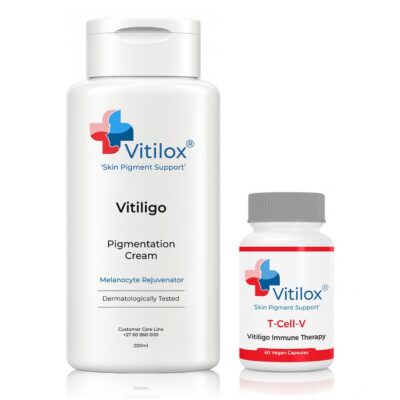
The Vitilox® Pigmentation Cream works directly on the affected skin to stimulate repigmentation, while the Vitilox® T-Cell-V Immune Therapy targets the underlying autoimmune response. Used together, they address the condition from both directions simultaneously.
The Role of Nutrition
Melanocyte function depends on specific nutrients — particularly vitamin B12, folic acid, and vitamin D3 — frequently deficient in people with vitiligo.
Nutritional deficiencies contribute to disease activity and slow the repigmentation process. The Vitilox® Vitamins B12, Folic Acid & D3 supplement has the correct ingredient levels to support melanocyte health, reduce further spread, and promote repigmentation over time.
What Results Actually Look Like
Repigmentation in vitiligo tends to begin at the hair follicles, which is why early signs of improvement often appear as small dots of returning colour within a patch — sometimes described as a speckled or stippled pattern. This is a positive sign. Over time, those dots expand and merge as more melanocytes migrate into the affected area.
The face, neck, and areas with higher hair follicle density typically respond better and faster than the hands, feet, and bony prominences. In all areas, consistency is the determining factor. The patients who see the most meaningful results are those who maintain their treatment regimen even when visible progress seems slow.
Starting Treatment: Where to Begin
The right treatment depends on your individual situation — the extent of your vitiligo, your skin type, where the patches are located, and whether your condition is currently active or stable. There is no single approach that works equally well for everyone.
Vitilox offers a free assessment to help match you with the correct products for your specific condition.
You Are Not Alone
Vitiligo affects an estimated 0.5% to 2% of the global population. For many people, the condition brings not only physical changes but social and emotional challenges.
The good news is that vitiligo can be treated. Real repigmentation is achievable. The Vitilox team has supported patients globally, and understands that every case is different. Whether your vitiligo is newly diagnosed or you have been managing it for years, it is never too late to begin a structured, evidence-informed treatment approach.
As always, please don’t hesitate to contact us if you require any further information pertaining to this article — Can Vitiligo Be Reversed? — or require any additional detailed information on our products.
We offer a free assessment so that we can understand which treatment plan works best for you 🔗 vitilox.com/vitiligo-assessments/
Vitilox® Global Store: https://vitilox.com/vitiligo/