
Vitiligo affects people of every skin tone, every ethnicity, and every background. But if you have a darker complexion, your experience of vitiligo is likely to be quite different from someone with lighter skin. The contrast is more visible, the emotional weight can be heavier, and the cultural context adds layers that many mainstream sources simply do not address. Here we discuss Vitiligo in Darker Skin Tones and What you need to know.
Why Vitiligo Shows More on Darker Skin
Vitiligo occurs when melanocytes — the cells responsible for producing pigment — are attacked and destroyed by the immune system. The result is patches of skin that lose their natural colour entirely.
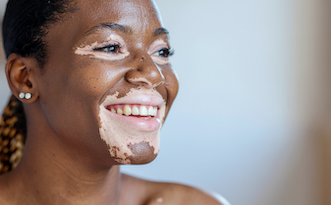
Vitiligo affects all races equally, but it is significantly more visible in people with darker skin tones. The reason is straightforward: the greater the natural pigmentation, the sharper the contrast between affected and unaffected skin. On a lighter complexion, early patches may be subtle and slow to be noticed. On darker skin, even small patches stand out clearly, often from the very beginning.
This increased visibility has real consequences. It means vitiligo can feel far more exposing — socially and emotionally — from the outset.
The Emotional and Social Reality
It would be wrong to treat vitiligo as purely a cosmetic concern, particularly for people living in communities where skin tone carries deep cultural significance.
Research confirms that vitiligo is more noticeable in individuals with darker skin tones, and that stigma is influenced by cultural differences. Studies of patients in Nigeria and Brazil show that stigmatisation has a measurable impact on quality of life. Quality of life impairment has been found to be greater in African, Middle Eastern, and South Asian populations than in many Western cohorts.
In some regions, vitiligo patches are still mistakenly associated with leprosy or other contagious conditions — a misconception that causes unnecessary social isolation. The burden can lead to stress, sadness, and low self-esteem. Anxiety and depression are also common.
These are real experiences, not minor concerns. Acknowledging them is the first step toward addressing them properly.

Getting the Right Diagnosis
Vitiligo can sometimes be confused with other conditions — including tinea versicolor, pityriasis alba, or post-inflammatory hypopigmentation — particularly in regions where dermatological services are limited.
If you have noticed white or lighter patches appearing on your skin, it is worth seeking a proper assessment. A dermatologist can use a Wood’s lamp examination to clearly distinguish vitiligo from other conditions, even in early or less obvious cases. Early identification matters because early vitiligo treatment consistently produces the best outcomes.
Vitilox offers a free online vitiligo assessment completed by a trained consultant, who will evaluate your condition and recommend the correct products for your individual skin type and coverage area.
Vitiligo Treatment That Works
The good news is that vitiligo treatment works in people of all skin tones, and vitiligo in darker skin tones is no exception. Consistency is the key factor. A structured approach — addressing both the immune response driving the condition and the skin’s ability to repigment — gives the best results over time.
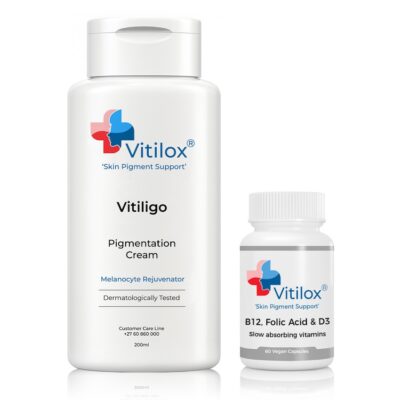
The Vitilox® Pigmentation Cream is a vitiligo cream formulated to work directly on affected skin, stimulating the melanocyte cells to begin producing melanin again. For lower body coverage, the Vitilox® Pigmentation Cream & Vitamins combination is a proven starting point. For more widespread vitiligo, the Vitilox® Pigmentation Cream & T-Cell-V pack addresses both the skin and the underlying autoimmune response simultaneously.
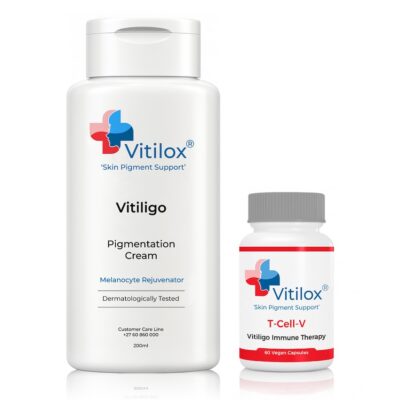
Nutritional support also plays an important role in helping to stop vitiligo spreading. The Vitilox® Vitamins B12, Folic Acid & D3 have been specifically formulated for the vitiligo condition — slow-absorbing, with the correct ingredient levels to support cell health, stop further spread, and promote repigmentation.
Vitilox does not offer a one-size-fits-all solution. The range is designed to match your specific condition, skin type, and coverage — which is exactly why the free assessment is the right place to start.
You Are Not Alone
Vitiligo affects an estimated 0.5% to 2% of the global population. For many people in Africa and Latin America, that means living with a condition that is both highly visible and frequently misunderstood.
If you are managing vitiligo in darker skin tones, know that the condition is treatable, that real results are achievable, and that you do not have to navigate it alone. The Vitilox team has supported patients across the globe and understands that every case is different.
Start with a free assessment — the sooner vitiligo treatment begins, the better the outcome.
About Vitilox
Vitilox products are formulated specifically for the vitiligo condition. Our consultants are available to guide you to the correct treatment for your individual skin type, coverage area, and vitiligo type. Visit vitilox.com to learn more or browse the full product range.
Vitilox Global Store: https://vitilox.com/vitiligo/